Sunday, October 4, 2015

Ghana - Post 2

Sustainability is becoming an ever-growing issue in sub-Saharan Africa, especially in Ghana. Because of this issue in Ghana and around the rest of the world, I do believe that the people of Earth have a moral obligation in order to keep the planet self-sustainable as soon as possible. I am doubtful that just depending on finding further ways to sustain the human population on Mars is a more inexpensive and reliable method as opposed to trying to "reduce, reuse, and recycle" what we have currently on the earth. Obviously, what we have here on Earth is finite, but that does not mean we cannot try to find multiple ways to use or recycle materials on Earth, even if it is at the cost of the corporations or others who are benefiting from our negligence to support the earth.

A video of possible water on Mars, via NASA


However, not all hope is lost in around the world as sustainability groups work in Ghana. Notably, water.org is working to improve water quality in the central African country. 

Water.org is working in two rural areas in Ghana: Volta Region around Lake Volta and Upper East Region, which borders Burkina Faso and Togo. Both districts are remote and poor, with less than half of the population unable to access safe water and very few families with access to improved sanitation. The rural areas suffer from many waterborne diseases, including diarrhea. Water.org and partner organizations work with communities to construct wells, latrines and biosand filters in Ghana as well as to provide health and hygiene education.
More than 80 percent of people in Ghana have access to safe water, but only 13 percent of people have access to improved sanitation. Dependency on unsafe water sources is higher in rural areas. Due to drinking contaminated water, diarrheal disease is the third most commonly reported illness at health centers across the country and 25 percent of all deaths in children under the age of five are attributed to diarrhea. In addition to lack of sanitation infrastructure, some cultural beliefs and views encourage people in rural areas not to use latrines. With our local partners, Water.org is educating and encouraging people to use latrines through community-led sanitation initiatives.

350.org also reports that a local group called G-ROC, short for "Ghana - Reducing Our Carbon," is attempting to politically shift the country in order to depend on more sustainable forms of energy.

G-ROC is a grassroots movement formed with the aim of mobilizing and empowering young people in partnership with key stakeholders to actively champion the need to reduce our carbon emissions as a key effort in combating climate change.
While the Facebook page only has 572 likes, approximately only 1.6 million people in the country use Facebook. There are more than 25 million people in the country, the per capita is only over $1,500, making it unviable for many of its citizens able to purchase a computer with Internet access or a home near a public place such as a library that is able to provide computers for its people.

Nonetheless, I think that Ghana is a country that is slowly but surely making its way towards further and greater attempts at keeping the world sustainable. Even if it is just within small communities, everything has to start somewhere. In the long run, I believe these efforts will make a difference globally.

Sub-Sahara Africa Madagascar Blog 2_Zihe Xi

     I believe we do have a moral obligation to take action to protect our planet, because human activities have led to environmental degradation on a vast majority of areas on our planet, and they have done plenty of harms to not only our environment, but also our people’s health and well-being and, even worse, the survival of some cultures. According to the article The Inuit Right to Culture Based on Ice and Snow, written by an Inuit activist Sheila Watt-Cloutier, global warming has a direct negative impact on their daily life. As Inuits, they inhabit in the Arctic regions; ice and snow represent transportation, mobility and life for them. For generations, they’ve been closely observing the environment, and accurately predict if the weather would allow them to travel safely by ice and hunt for their food. However, due to the recent global warming phenomenon, their ability of accurately predicting weather has been disturbed. The reduction of sea ice has made their transportation vehicle becoming increasingly limited and unreliable. People’s life are endangered, drowning has happened to many Inuits when they are crossing seas that they thought they would cross through. Furthermore, many marine species in Arctic are facing extinction, including polar bears, ice-living seals, walrus and some marine birds. While typical Inuits diet consists these animals, Inuits population is decreasing with the declining of these animal species. Therefore, what environmental degradation has done is way beyond the damage to environment, it has imperiled human’s well-being, especially those of children’s; what’s worse, it may even cause the disappearing of many valuable and exotic cultures such as the Inuit culture. All these disastrous consequences are mostly, if not solely, results of human activities. To develop economies, governments are taking short-term view that is favored by many businesses, which results in severe environmental destruction. Humans took the advantage of the environment to serve our own benefits and greed, now that the environment has helped us to achieve our desired development, and I do feel we have a moral obligation to give what we have taken, to take action and protect the future of a planet in peril.

(Traditional Inuits)


     One of the most prominent consequences of environmental degradation is the decrease in cultural and biological richness in many regions, such as Madagascar. According to wildmadagascar.org, this country’s major environmental problems include deforestation and habitat destruction; agricultural fires; erosion and soil degradation; overexploitation of living resources including hunting and over-collection of species from the wild and introduction of alien species. Among them all, soil erosion is the greatest concern, this came from an insightful observation—due to soil erosion, rivers looked like they were running blood red and staining the surrounding Indian Ocean, astronauts have remarked that it looked like Madagascar is bleeding to death. 
(Betsiboka River of Madagascar, photo taken by NASA )


    According to my research, water.org is not involved in Madagascar, however, other environmental groups, including Wildlife Conservation Society and World Wildlife Fund are working in Madagascar, in an effort to prevent further environmental degradation and preserve the island’s unique ecosystems and biodiversity. Specifically, Wildlife Conservation Society is striving to ensure the conservation of the island’s unique floral and faunal diversity, while World Wildlife Fund is mainly focusing on preventing Madagascar’s further deforestation.
(Lemurs, a unique animal specie in Madagascar that the WCS is trying to protect)

References:
Sheila Watt-Cloutier The Inuit Right to Culture Based on Ice and Snow, Web.
http://www.nasa.gov/topics/earth/features/astronauts_eyes/iss010e19333_prt.htm


Sub-Sahara Africa: Somalia

Sub-Sahara Africa

Somalia

I believe that mankind has taken for granted the beautiful situation we were given being able to live on this planet. It seems that people and corporations are so focused on their own short term goals rather than creating a stable future for their own children. Our technological advancements and the globalization that has taken place over the recent decades is impressive to say the least.
 
Even with our technological advancements we need to be intelligent enough to consider the future impact that our waste will create. Humans, without a doubt, have a moral obligation to take care of our world for we do not have another if we destroy this one. Parents are always trying to give their children the most opportunities and the brightest future they possibly can so we must act as the parents of our own planet. Therefore, we need to take action against problems like global warming not only for our own sake but for the sake of our children.
 
The picture below shows a group of Penguins forced onto a small island due to global warming.


It is without a surprise that Somalia, being one of the poorest countries in the world, has problems maintaining their environment. Without a central government there seems to be no one taking the responsibility of taking care of their land. Land degradation is a form of excessive erosion causing desertification, which is making a dry land even worse by losing its bodies of water. With the water in the land leaving the vegetation and wildlife has no chance of surviving, effectively destroying an ecosystem. I believe that this is an even greater problem in a third world country that depends on the wildlife for food and the wilderness for resources. There isn't stable land to sustain livestock and the dried up dirt makes it impossible to farm.

Charcoal is an important energy source for African countries as well as provides jobs for the people, but is a main cause of the deforestation. Somalia can make quick money off of their charcoal but their inefficient ways of production damage the environment. The use of charcoal puts pollution into the air and destroys wood resources, which the country is already lacking. A lot like global warming Somalia is focused on their short term profits instead of considering the long lasting impact of their actions on their own environment. It is the strong foreign demand for their product that encourages them to continue to produce charcoal.
 
 Below is a small example of the deforestation plaguing the country of Somalia

 
The United Nations Environment Programme started the Joint Needs Assessment (JNA) along with the World Bank in an effort to identify the issues in the Somalian environment. However, the ongoing civil war left the effort with very little relevant data to use but the JNA stated this was a very important first step.
 
This is a photo of some of the Somalian wildlife that died off because the lack of vegetation
 
Water.org does work in the Sub-Sahara Africa region but they do not work in the country of Somalia itself. I'm assuming this is because of the dangerous environment due to the constant civil war in the country. They do work in two of Somalia's neighboring countries of Ethiopia and Kenya. Ethiopia is one of the countries hit hardest by drought and failure of crops, but the program is helping 32,000 people. In Uganda many people just use springs to get their water instead of pipes. The springs are easily contaminated by the lack of drainage and no regulation of waste disposal. Right now the group isn't able to help more than a handful of countries in Africa but hopes to increase their reach in the future.
 
 
Sources:


Wednesday, September 23, 2015

TANNER FEDERSPILL

Sub-Sahara Africa

Somalia

The jihadist militant group known as Al-Shabaab has recently attacked and taken control of an army base in southern Somalia this past week. During the attack it is reported that Al-Shabaab killed 13 soldiers in the attack. The jihadist terrorist group has had control of many of the southern villages of Somalia since 2010 and have imposed their strict Islamic laws. They often stone people to death, hold public beheadings, and even amputate the arms and legs of those accused of various crimes. I for one can't even imagine living in a society where these are possible consequences for breaking the law, I think it is crucial that these men are taken out of power.

If you'd like to read more into the situation here is the link to the article:
http://www.voanews.com/content/al-shabab-overruns-somali-military-base/2969067.html

The photo below shows the current claims on Somalian territory from the different powering groups.

While the country of Somalia is in a constant state of war, women are in a constant fear of rape and abuse. Women have reported to experiencing high levels of sexual abuse not only from other civilians or jihadist militant groups but also from government officials in Somalia's own capital. Liesl Gerntholtz, a women's rights director at Human Rights Watch, states "The Somali government's public commitments have not materialized into better protection for women and support for victims." It seems that sexual violence isn't even fought in Somalia but considered a part of the norm and integrated within their culture.

The UN reported over 800 sexual violence cases in the first six months of 2013 in Mogadishu alone, the capital of Somalia. About a third of these victims are reported to be children under the age of eighteen. This is a troubling number and clearly something that the Federal Government of Somalia needs to address. It seems crazy to me that a countries capital can be so corrupt and violent on this level. 

This past week over five hundred women gathered in Mogadishu to protest. They were protesting the increasing number of attacks from Al-Shabaab's militants. The women called out Al-Shabaab claiming that Al-Shabaab is not fighting a religious war for the sake of the country. On the contrary, the women who spoke at the rally are citing Al-Shabaab as the sole reason their country has thousands of casualties and the political turmoil it can't seem to get out of. I think Asha Koos, the speaker at the rally, is accurately placing the blame on Al-Shabaab since I don't believe the Somalian government can truly start to rebuild. They need to get one group into power with the right intentions for the country of Somalia. 

Somali women protest Al-Shabaab in Mogadishu

As for the economics of Somalia, they aren't even rated because the lack of a central power controlling their imports, exports and the overall instability of their government. Other unranked countries like Afghanistan and Iraq are all considered repressed places to live. The living standards are among the lowest in the world while the country depends on outside help in order to feed their citizens.The many different militias and governmental groups claim territory throughout Somalia with their own laws each enforce. Somalia's industrial capabilities are very minimal. The country can produce textiles from their factories and refine petroleum. Their exports include livestock, charcoal, and fish.
If you'd like to see the countries rankings and ratings follow the link below.


Above is a simple graph showing Somalia's GDP over the past 40 years.
Sources:
ZIHE XI
     Nationalism is a sentiment based on the same geographical and demographic region as well as common cultural and political backgrounds that holds a group of people together; it usually produces a feeling of patriotism and national independence. Nationalism in Madagascar had deep historical roots. As early as in 1947, Malagasy nationalists started a rebellion against French colonial rule. Before the rebellion took place, Madagascar’s first French National Assembly deputies attempted to achieve national independence through legal measures, but the initiative was turned down and returned with a harsh response, which radicalized the Malagasy nationalists and led them to launch an attack against military bases and French-owned plantations. Soon after the rebellion started, the French began to fight back against the nationalists. With a troop that tripled in size and a much stronger military force, the Malagasy nationalists suffered a great loss, with an estimated number of 100,000 casualties. The Uprising was eventually put down by the end of 1948.

 
(Pro-independence activists submit to French arrest during the 1947 rebellion)

     The rebellion was a failure to Malagasies, and one of the biggest post-war colonial massacres. According to historian Philippe Leymarie, “It (the Madagascar Uprising) destroyed a whole generation of Madagascar’s managerial class and intensified the country’s problems. Madagascar, once proud and united, has been ruined by foreign interference and has been unable to recover its traditional equilibrium.” (Leymarie, web) Although with such severe consequences, I still think that the Madagascar Uprising had some good aspects to it; I believe it further solidified its people, strengthened their patriotism, and gave them a better idea the real capability of their country. Just like one of Madagascar’s previous prime ministers—Guy Razanamasy once said “The uprising made us realize we were Malagasies. It was the whole country, not just the Merinas.” (Razanamasy, web) In the late 1970s, a few decades later after the rebellion, people were gradually stepping out of the sorrow of loss, and began to celebrate the Uprising anniversary with pride and gratitude, as “a revolution which admitted failed, but which opened they way to future nationalst struggles.” (Fanony and Guennier, 1997) More recently, in 2012, a museum dedicated to the Madagascar Uprising was officially opened in Moramanga.  

 (The Malagasy Uprising against French colonial rule, which began on 29 March 1947, is commemorated by a national monument in Moramanga.)

     Although celebrated in many countries, nationalism faces dangers as it rises. One of the dangers, as Zakaria explained in his book, is the conflict between nation-state identity and religious, ethnic identities that live within nation-states. Zakaria stated that the rise of nationalism in his opinion refers to a broader phenomenon—the assertion of identity; and while the religious and ethnic identities have actually had a much longer history than those of nation-state, they have stayed strong and even grown as economic interdependence deepened. This creates conflicts when it comes to governing; the central government might become increasingly unconvincing to some groups of people. Or in Zakaria’s words, “it makes purposeful national action far more difficult.” (Zakaria, pg.41)


     As one of the poorest countries in the world, Madagascar faces the serious income inequality. Study shows that 77% of the population in Madagascar lives on 1.25 US dollars a day, 70% of the population is poor and 50% is extremely poor. According to a study conducted to investigate the trends in Madagascar’s income inequality from 2001-2005, there’s great income differences at the provincial level, separated by urban and rural areas. Although data shows that inequality actually decreased through out the nation, the provincial trends show a significant dispersion in inequality reduction rates. The study concluded that “what dominated inequality changes between 2001 and 2005 was the contribution from changes in inequality within provinces and within urban/rural areas. ”  (Amendola, 2008)The table below better explains this key finding.


Sources:

http://mondediplo.com/1997/03/01madagascar
https://en.wikipedia.org/wiki/Malagasy_Uprising

Pryor, Frederic L. The Political Economy of Poverty, Equity, and Growth: Malawi and Madagascar. New York: Published for the World Bank Oxford UP, 1990. Print.


DOSTALER GhanaWeb.com writes that Ghana and Burkina Faso have been forced to tighten their borders.

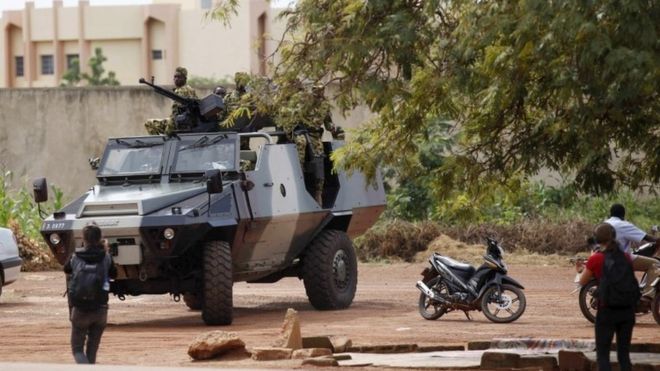
According to the Telegraph of London, England, a coup broke out in Burkina Faso on September 17, causing the death of at least three people and injuries to 60 more civilians. The coup comes as a result of the popular uprising that forced long term president Blaise Compaore out of office on October 31, 2014. As a result of the coup, the military now currently is in power within the country as General Gilbert Diendere, who served as the chief military advisor for President Compaore for more than 30 years. Deindere had also served as the equivalent of the head of Secret Service for the President of the United States, and said that elections would not happen but there was not a specific date set.

Ghanian radio conglomerate MyJoy wrote that the United Nations, led by Secretary General Ban Ki-Moon, have condemned the coup d'etat and called for the immediate release of its temporary leaders.

"The Secretary General condemns in the strongest terms the coup d'etat in Burkina Faso. He reiterates that all Burkinabé officials under detention must be released immediately and demands the resumption of the country's political transition, in accordance with Burkina Faso's Constitution and Transitional Charter," said a statement issued by a spokesperson of the Secretary General.

"The Secretary General deplores the violence reported in the country and calls on the Burkinabé defense and security forces to exercise restraint and ensure respect for the human rights and security of all Burkinabé citizens. Those responsible for the coup d'etat and its consequences must be held accountable."

International security advisor to President Obama Susan Rice said that the United States and the international community were ready to be on call for the international crisis if needed.

"The (military) junta should step aside and allow preparations for the October elections to resume immediately. The U.S. stands squarely with the people of Burkina Faso in rejecting this threat to their democratic progress," she said in her keynote address to the Congressional Black Caucus Foundation's Legislative Conference in Washington, D.C.

While I think it is completely reasonable for the military of Burkina Faso to want its voice heard, I am sure that it already had had plenty of power to begin with, and because of that, its overthrow of the provisional government is not acceptable. The people had wanted to oust their leader for some time and the chance for a new regime had happened until their military personnel felt that the direction of the country would not bring benefits to them like the old government had, and selfishly and forcefully overthrew the temporary government. If they really wanted a say, they should have promoted and voted for a candidate of their preference. Even if there is a small chance someone like the old president would have been elected, it is for the greater good of the country that this change would happen. Now that they have tried to take the government by force, this will never work out in their favor. However, this coup d'etat is affecting more than just the government of Burkina Faso. Ghana has seen issues arise from this as well.

25 Ghanian leaders are currently held up in their hotel in the capital in the Burkinabe capital of Ouagadougou as they were in the city for a natural conservation conference, according to GhanaWeb. The National Coordinator of Shea Network Ghana, Zakaria Iddi, says attempts to reach out to the Ghanian embassy were unacceptable.

It still remains to be seen what will happen to these leaders as Deindre says he will not leave office until the new government is put into place, according to the BBC.

Photo via Reuters

Friday, September 11, 2015

Cameroon

Located in the heart of Sub Saharan Africa lies a country full of rich cultural heritage, beautiful coastal landscapes, and abundant wildlife. Cameroon, being one of West Africa's most populated countries, consists of 16.3 million people and spans over more than 475,000 square miles. One of Cameroon's most unique characteristics is that it consists of many different ecosystems. Without ever crossing the borders of this country, one can see vast mountain ranges, dense tropical forests, ocean coastline, and dry, hot deserts. Like any country, this diverse ecosystem and geographical location affect what natural resources are available as well as who this country trades with, which in turn affects the economy. Economical prosperity relies very heavily on geography, climate, natural resources, and even government, and Cameroon is no exception.

Cameroon's primary exports include oil, livestock, coffee, rubber, and timber. They trade with countries all over the world including the United States. Cameroon's hundreds of miles of ocean coastline has proven very advantageous to the success of their trade. Along with the United States, some consistent trade partners with Cameroon include, France, Netherlands, Spain, and Canada. The vast success of Cameroon's imports and exports are a strong part of why Cameroon is considered one of Africa's strongest economies.

Cameroon's economic standing is relatively favorable, especially in comparison to some of the third world countries surrounding it. Their GDP is equivalent to about $53 billion in United States currency.Their unemployment rate is also respectable at about 4.0%. One big issue that Cameroon faces is the regularity of corruption inside the walls of their parliament. It is not mandatory for public officials to file reports on revenue for the state. This gives these officials ample opportunity to steal from their taxpayers and their country, and signs hint to the fact that they take full advantage of that loophole. This, in my opinion, points to a great deal of flaws in their political system. If government officials don't have to give reports on revenue, then what do you expect them to do? I am sure that this just scratches the surface of the internal problems Cameroon faces daily. And until these problems are fixed, their economic growth will come to a stalemate.

Globalization touches on almost all aspects of life: social, cultural, political, and environmental. Interestingly enough, some parts of Africa are still very tribal and extremely isolated. Recent technologies or innovations of the last few centuries have not been exposed to these minute groups of people. With a few exceptions, Cameroon is much more relevant on a global scale than its neighbors and counterparts. They are a big player in international trade, have diplomatic relations with numerous countries all over the world, and have an established political system similar to one found on any other continent of the world. Although at a very slow rate of growth compared to the world's superpowers, Cameroon is still a very culturally rich, self sustaining country in Sub Saharan Africa. Interestingly enough, my cousin is in the United States Marine Corps and is currently stationed at the US embassy in Cameroon. I hope to get a unique insight from him from a personal point of view as I delve further into the political, social, economic, and cultural aspects of this country.
Image result for cameroon  Image result for cameroon
SOURCES:
http://www.heritage.org/index/country/cameroon
http://travel.nationalgeographic.com/travel/countries/cameroon-facts/
http://www.economywatch.com/world_economy/cameroon/export-import.html